
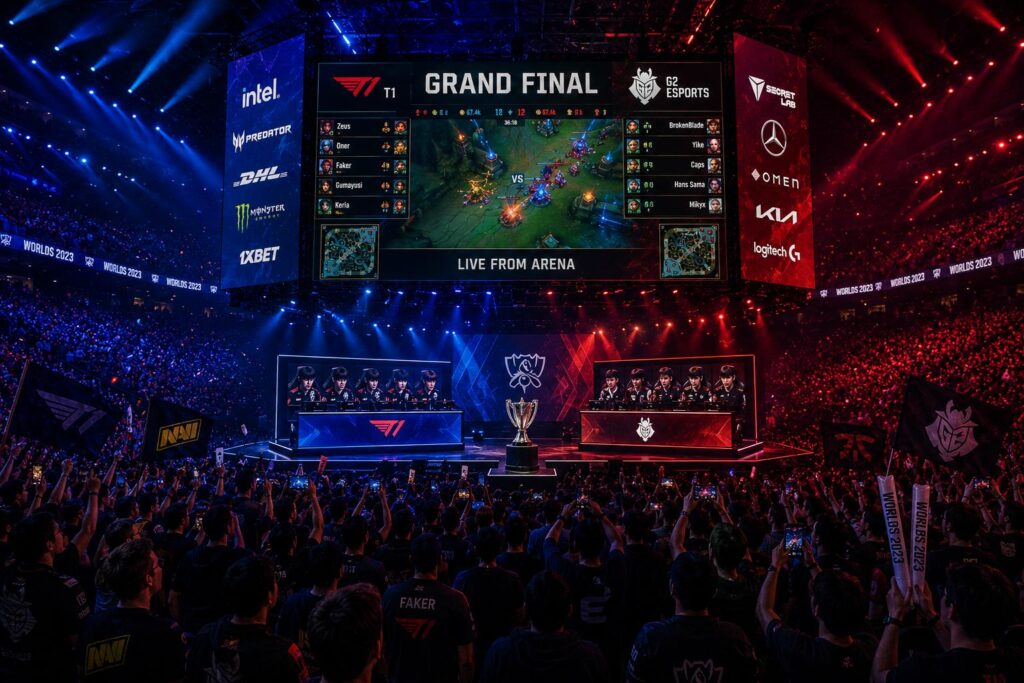
The transition from a bedroom hobby to a massive arena spectacle is a journey very few video games ever complete. No more than 2 dozen games have become respected e-sports titles, with a projected market capitalization of $2.5b in 2028 (source: Statista). CS:GO and Valorant fit this mold perfectly with their round-based systems. Apparently, older games with seemingly dated graphics continue to pull in thousands of fans and offer prize pools worth millions of USD. Let’s find out why.
Competitive DNA
Some video games feel like they were born for the stage. When developers sit down to create an immersive world full of quests, they are usually focused on player retention or visual flair (usually both). However, the titles that eventually transform into e-sports have a lot in common.
Let’s face it: all sports act as mirrors of the athlete’s capability. LoL, FIFA, or Valorant are no different. If you are better than your opponent, the mechanics should allow you to prove it. Experts at Newzoo, a leading provider of games market data, call it the ‘skill ceiling’. All e-sports titles allow infinite mastery.
What Makes a Game Hot
Counter-Strike, StarCraft II, and League of Legends all praised for their high skill ceiling. Then there are mobile/PC hits like Candy Crush Saga or The Elder Scrolls Online, where progression is tied to how much time you spend grinding or how much $$$ you pour into microtransactions. Comparing skills is somewhat pointless.
For a title to thrive as a sport, the community must agree on one thing: the best person wins. When randomness or pay-to-win mechanics enter the frame, the legitimacy of the competition vanishes. David Sirlin, a former pro player and game dev, once wrote that for a title to be competitive, it must be ‘stable’. The rules can’t change in ways that invalidate a player’s expertise.
Twitch Stats
Let’s meet Dwarf Fortress: the most complex simulation game ever made (it’s been in development since 2002 – really!). Veteran players will enthusiastically describe fortress designs of genuine engineering brilliance. Watching someone else play it, though, feels like staring at a spreadsheet having a nervous breakdown. No broadcast format saves that.
What’s missing there is the drama. Moments that communicate meaning even to people who’ve never touched the game. The 2016 Dota 2 International produced one of the most discussed plays in e-sports history when Miracle- pulled off a near-impossible 1v5 comeback for OG. People who barely knew what Dota 2 was shared that clip, because the tension was universal. Someone was losing badly. Then they weren’t. That’s a story anyone understands.
Riot Games reportedly spent significant internal resources studying how League of Legends reads on a broadcast screen — adjusting camera angles, UI elements, and even champion visual designs specifically to make professional matches easier for casual viewers to follow. That’s not an accident. They understood that entertainment value and viewer accessibility were important factors.
The most-watched e-sports titles on Twitch all shared one trait: peak moments of action that compressed into short, shareable clips. The algorithm and the arena crowd want the same thing — explosive, readable, emotionally satisfying moments.
The Betting Factor
Games attract betting interest when they offer clear, measurable, time-bound outcomes with enough predictability for markets to form around them. CS:GO is almost perfectly designed for this by accident — matches have defined map structures, clear scorelines, and enough variables (pistol rounds, economy management, clutch situations) that sophisticated bettors can find edges without the whole thing collapsing into chaos.
Battle royales, for all their mainstream popularity, have struggled with this. Fortnite is the most-played game on the planet (across certain demographics, at least), yet it is not the most popular title at Polish bookmakers and on other online sports betting markets. It’s not hard to say why: forty-person lobbies with randomized circle placements and storm timing introduce variance that’s difficult to bet around. Try broadcasting that all.
When betting markets open around a title, something almost mechanical kicks in. Viewership increases because bettors watch matches they have money on. Media coverage expands because outlets follow audience interest. Money from the sponsorship contract flows in because brands get attracted by increased exposure.
Final Thoughts
The path from a popular game to a legitimate e-sport is narrow. It requires a rare mix of competitive integrity, visual clarity, human drama, and a business structure. Most titles fail to hit even two of these marks. Some, on the other hand, become pop culture phenomena. They become a career path and a global language of competition.
When you watch a pro player make a move that seems impossible, you aren’t just watching software. You are watching the limit of human potential.
 Ask Frances Nunesards how they got into hot topics in gaming and you'll probably get a longer answer than you expected. The short version: Frances started doing it, got genuinely hooked, and at some point realized they had accumulated enough hard-won knowledge that it would be a waste not to share it. So they started writing.
What makes Frances worth reading is that they skips the obvious stuff. Nobody needs another surface-level take on Hot Topics in Gaming, Gaming Setup Optimization Tips, Expert Breakdowns. What readers actually want is the nuance — the part that only becomes clear after you've made a few mistakes and figured out why. That's the territory Frances operates in. The writing is direct, occasionally blunt, and always built around what's actually true rather than what sounds good in an article. They has little patience for filler, which means they's pieces tend to be denser with real information than the average post on the same subject.
Frances doesn't write to impress anyone. They writes because they has things to say that they genuinely thinks people should hear. That motivation — basic as it sounds — produces something noticeably different from content written for clicks or word count. Readers pick up on it. The comments on Frances's work tend to reflect that.
Ask Frances Nunesards how they got into hot topics in gaming and you'll probably get a longer answer than you expected. The short version: Frances started doing it, got genuinely hooked, and at some point realized they had accumulated enough hard-won knowledge that it would be a waste not to share it. So they started writing.
What makes Frances worth reading is that they skips the obvious stuff. Nobody needs another surface-level take on Hot Topics in Gaming, Gaming Setup Optimization Tips, Expert Breakdowns. What readers actually want is the nuance — the part that only becomes clear after you've made a few mistakes and figured out why. That's the territory Frances operates in. The writing is direct, occasionally blunt, and always built around what's actually true rather than what sounds good in an article. They has little patience for filler, which means they's pieces tend to be denser with real information than the average post on the same subject.
Frances doesn't write to impress anyone. They writes because they has things to say that they genuinely thinks people should hear. That motivation — basic as it sounds — produces something noticeably different from content written for clicks or word count. Readers pick up on it. The comments on Frances's work tend to reflect that.